
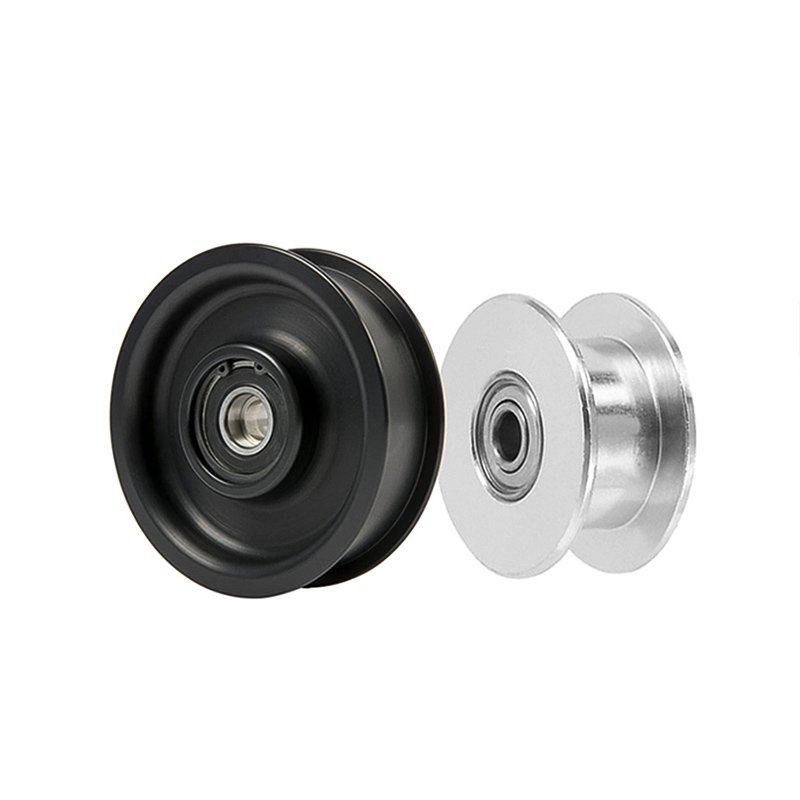
A smooth timing belt idler can guide the back of a timing belt or help set installation tension. Provide the belt details and drive layout so we can review the running face, flange clearance, and mounting arrangement.
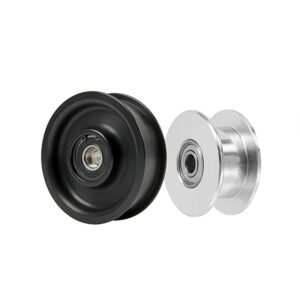
Belt Contact and Idler Position
Identify the belt manufacturer, series, and width, and show where the smooth face contacts the belt. Check the belt maker’s minimum backside idler diameter for that belt and duty. Include the idler position, available adjustment, and intended wrap angle. For the toothed component that transmits motion, see Timing Pulleys.
Running Face, Flanges and Bearing Fit
- Pulley profile: Specify outside diameter, usable face width, flange height and axial clearances. Allow clearance for the belt edges as the belt tracks.
- Mounting: Provide the shaft or bearing part number, seat fit, spacers, and axial retention. State the bearing and hardware scope separately. Include rotational speed and the radial load from belt tension.
Aluminum Grade and Surface Finish
6061 and 7075 aluminum are drawing options. Specify the grade and natural, black, or custom anodizing where required. Identify bearing seats and running surfaces with controlled coating thickness or roughness. Explore our CNC machining processes.
Dimensions and Inspection
- Fit and diameter: Drawing references include an H7 bore or a separately specified bilateral bore tolerance of ±0.01–0.02 mm, an outside diameter tolerance of ±0.02–0.05 mm, and general dimensions of ±0.05 mm where specified.
- Runout and surface: References include concentricity ≤0.02 mm and runout ≤0.02 mm. Define the bore datum and measured surface. For roughness in the Ra 0.8–1.6 μm range, give a single maximum for each controlled surface.
Request a Smooth Idler Pulley Quote
Send the belt series and width, drive layout, pulley drawing, bearing or shaft requirements, grade, finish, and quantity.
Discuss your smooth idler pulley project or email eleven@grancen.com.
Reviews
There are no reviews yet.