
A clear request for quotation (RFQ) helps a machining supplier understand the real manufacturing scope before pricing begins. For international buyers, the RFQ package also creates a common reference for engineering, purchasing, quality and logistics teams. It does not need to answer every question, but it should separate confirmed requirements from open decisions.
The goal is not simply to attach a model and ask for a unit price. A useful package explains the part geometry, material, quantity, critical features, finish, inspection expectations and delivery context. That information allows the supplier to review manufacturability and identify assumptions before they become production problems.
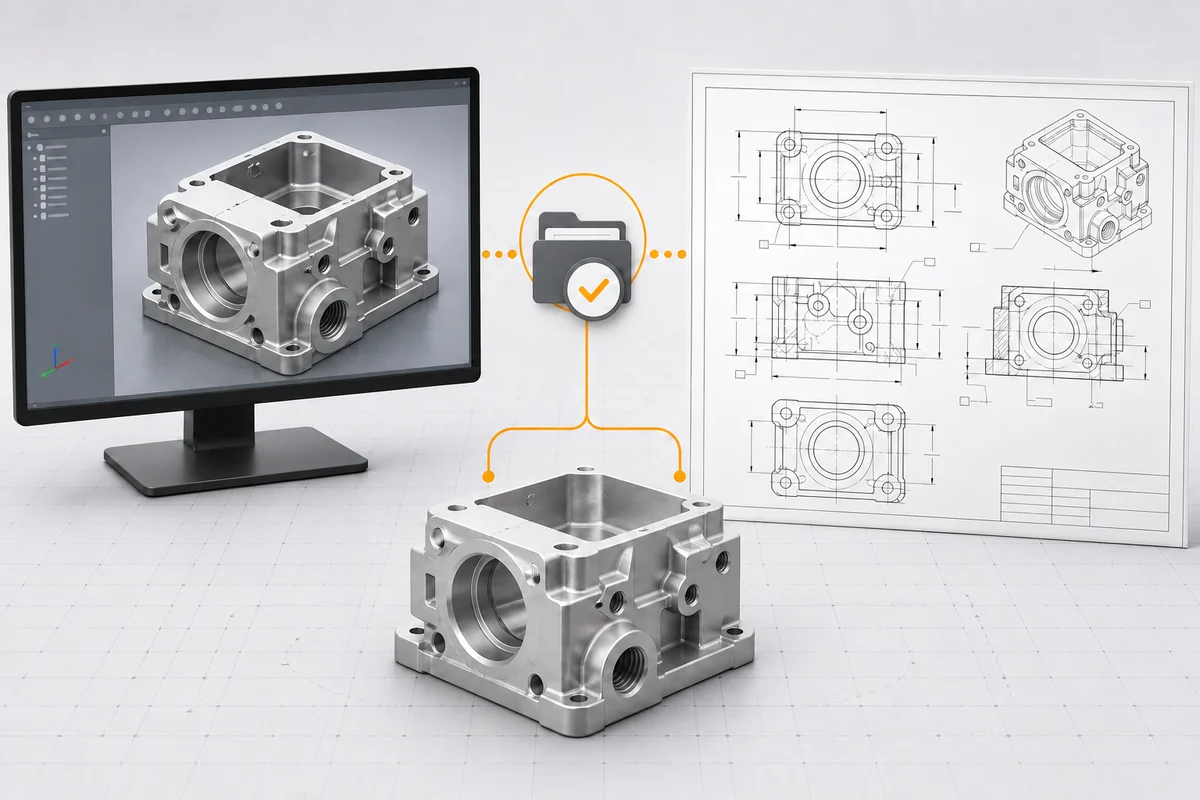
Start With Controlled 3D and 2D Files
Send a 3D model and a dimensioned 2D drawing when both are available. The model communicates geometry efficiently, while the drawing carries information such as datums, tolerances, threads, surface-finish notes and inspection requirements. Confirm that both files represent the same revision.
- Use clear filenames with the part number and revision.
- Identify which document controls if the model and drawing differ.
- Remove obsolete files from the package.
- Note whether the design is released or still open to DFM changes.
Neutral formats such as STEP are commonly useful for geometry exchange, while a PDF drawing gives purchasing and quality teams a stable reference. Native files can be added when they contain information that is not preserved in the neutral export.
Define Material and Quantity Without Guesswork
Names such as “aluminum,” “stainless steel” or “plastic” are often too broad for quotation. State the preferred grade, condition or temper, and list acceptable alternatives only when they genuinely meet the application. If the choice is still open, explain the functional priorities—such as weight, corrosion exposure, wear, temperature or finishing—and request a material review.
Quantity changes the manufacturing plan. Include the first-order quantity, expected repeat quantity or annual range if known, and whether a sample or first-article approval is required. Also state whether later orders are expected to use the same revision. This gives the supplier context for workholding, programming, inspection planning and possible fixture investment.
Identify Critical Features and Acceptance Criteria
Applying tight tolerances everywhere can add machining and inspection effort without improving function. Mark the dimensions and geometric relationships that control assembly, sealing, alignment, bearing location, motion or load transfer. A coherent datum scheme helps the manufacturing and inspection teams interpret those relationships in the same way.
Include thread standards, insert requirements, edge conditions and any dimensions that apply after coating. When a requirement is uncertain, provide mating-part or assembly context instead of inventing a limit. The supplier can then raise a focused DFM question during review.
Describe Finishing and Cosmetic Requirements
A finish name alone may not define the result. Specify the process, color or reference standard, gloss or texture, masked areas and surfaces that must remain conductive or dimensionally controlled. Mark cosmetic A, B and C surfaces when appearance varies by location. If a physical sample controls color or texture, identify it in the RFQ and agree how it will be approved.
Set the Inspection and Documentation Scope
Inspection requirements should match part risk and the agreed drawing. State whether the order needs standard final inspection, a selected dimensional report, a first-article report, material documents, functional testing, special marking or traceability. Define the required format before quotation so the quality plan and commercial scope remain aligned.
A measurement request should also identify the controlling datum setup and the features that matter most. This is especially important for parts with multiple orientations, complex profiles or relationships that cannot be assessed reliably from a single measurement method.
Include Packaging and Delivery Information
Packaging is part of the manufacturing scope for precision and cosmetic components. Tell the supplier about protected surfaces, thread or edge protection, cleanliness restrictions, corrosion protection, labels, lot identification and any restrictions on part-to-part contact. Include the delivery destination, target schedule and whether split deliveries or staged releases are useful.
Use This RFQ Checklist Before Submission
- Current 3D model and dimensioned 2D drawing
- Part number, drawing number and revision
- Material grade or clearly stated performance requirements
- Prototype, first-order and expected repeat quantities
- Critical dimensions, datums and tolerances
- Threads, inserts and assembly interfaces
- Surface finish and cosmetic zones
- Inspection and documentation requirements
- Packaging, marking and delivery information
- Known risks or lessons from earlier builds
If some items are unknown, mark them as open questions. Clear uncertainty is more useful than an assumption hidden inside a drawing or email.
What Happens After Grancen Receives the RFQ?
Grancen reviews the available drawings and requirements before preparing the quotation. The engineering discussion may cover material, tool access, workholding, tolerances, finishing, inspection or packaging. Resolving these points helps establish a manufacturing plan that matches the released requirements.
Buyers can review Grancen’s CNC machining capabilities before submitting a project. When the files are ready, use the existing request-a-quote form to share the project information through the approved inquiry route.