
Choosing between 3-axis and 5-axis CNC machining is not a contest between basic and advanced equipment. It is a process-planning decision. The best route is the one that reaches the required features, protects functional relationships and supports inspection without adding unnecessary programming, workholding or handling.
For overseas buyers, the distinction matters because machine selection affects setup count, tool access, fixture strategy, quotation and the information a supplier needs. This guide explains how to compare both processes from the drawing rather than selecting a machine label in advance.
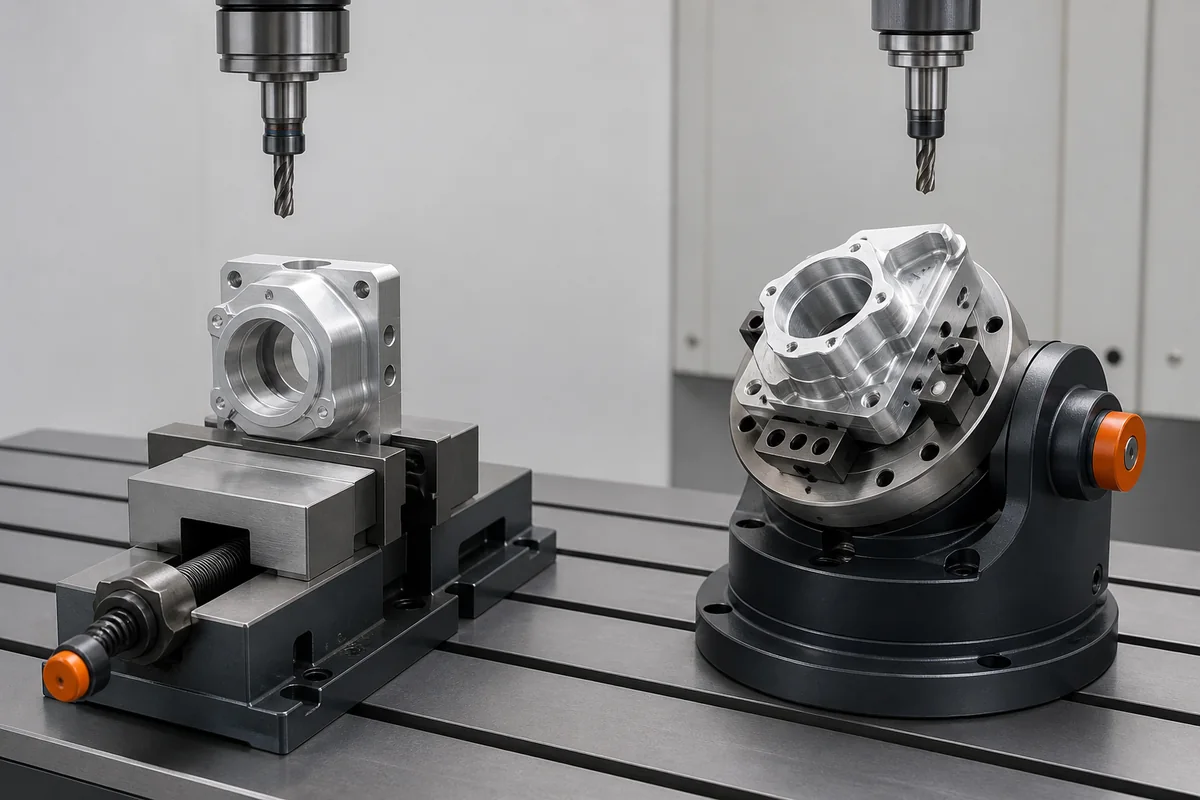
What Changes Between 3-Axis and 5-Axis Machining?
A 3-axis milling machine moves the cutting tool along the X, Y and Z directions. It is well suited to accessible faces, planar surfaces, pockets, holes and other primarily prismatic geometry. Features on additional sides can still be produced by repositioning the workpiece in planned setups.
A 5-axis process adds rotational movement so the part or tool can be presented at different angles. The strategy may use indexed 3+2 positioning, where the workpiece is oriented and then cut with linear motion, or simultaneous movement for changing contours. The customer usually does not need to prescribe the motion type; the drawing and acceptance requirements should give the manufacturer enough information to plan it.
| Decision factor | 3-axis machining | 5-axis machining |
|---|---|---|
| Typical geometry | Plates, brackets, blocks and accessible pockets | Compound angles, changing contours and closely related multi-face features |
| Workholding | May use several straightforward setups | May reduce manual reorientation for suitable parts |
| Tool access | Effective when features face practical cutting directions | Can orient angled or obstructed features toward the tool |
| Programming | Usually more direct for simple geometry | May require more planning, simulation and verification |
| Best value | When added axes do not solve a real constraint | When setup reduction, access or feature relationships justify the route |
When 3-Axis CNC Machining Is the Practical Choice
3-axis milling remains an efficient option for many custom components. A plate, mounting bracket, rectangular housing or machined block may have all important features accessible from one face or a small number of clear orientations. Standard fixtures can locate these parts reliably, and the machining and inspection plan may be simpler than a multi-axis alternative.
Multiple setups are not automatically a quality problem. They are manageable when datum surfaces are clear, workholding is stable and feature relationships can be recovered consistently. For repeat production, a straightforward fixture and proven setup sequence can also support predictable processing.
When a 5-Axis Route May Add Value
Angled and multi-face features
Inclined bores, tilted sealing faces, compound mounting interfaces and features distributed around several sides are common reasons to evaluate 5-axis machining. If related features can be cut from one stable setup, the route may reduce repeated datum recovery and handling.
Difficult tool access
Long cutting tools are more flexible than short tools. Tilting a feature toward the spindle may allow a shorter, more rigid cutter to reach a deep pocket or an obstructed surface. This can make deflection, vibration and surface consistency easier to manage, although thin walls and flexible sections still require suitable support.
Complex contours
Simultaneous 5-axis motion can be useful for changing contours that would otherwise require many fixed orientations. Tool direction can change as the path moves across a surface. Final results still depend on programming, workholding, tooling, material behavior and inspection; the number of axes alone is not a quality guarantee.
Why Fewer Setups Do Not Always Mean Lower Cost
A 5-axis route may replace difficult fixtures, reduce handling or protect a critical relationship between features. However, machine time, programming, simulation and verification can be more demanding. If a part is accessible from a few conventional orientations, a 3-axis plan may remain the lower-risk and more economical choice.
A useful quotation compares the complete manufacturing route: setup count, fixture complexity, tool length, removed material, programming effort, critical datums, inspection access and quantity. The aim is to choose the simplest capable process, not the most advanced machine available.
Provide the Information That Drives Process Selection
- Controlled 3D model and dimensioned 2D drawing
- Material and grade
- Prototype and expected production quantities
- Critical dimensions, tolerances and datum relationships
- Angled, contoured or multi-face features that drive the design
- Surface finish and post-processing requirements
- Mating-part context where it explains function
- Required inspection records and acceptance criteria
Machining and measurement should follow the same datum logic. A sophisticated toolpath cannot compensate for an unclear functional reference system. Identify which relationships matter and whether dimensions apply before or after finishing.
Frequently Asked Questions
Is 5-axis machining always more accurate?
No. Accuracy depends on the machine condition, workholding, tool strategy, datum definition, material behavior and measurement method. A 5-axis process may reduce certain setup-related risks, but it does not replace sound process planning.
Can 5-axis machining be used for prototypes?
Yes. It can be appropriate when a prototype contains compound angles, complex contours or important multi-face relationships. The route should still match the project quantity, learning goal and expected production path.
Choose the Process From the Drawing
Choose 3-axis machining when the component is primarily prismatic, features are accessible and planned setups can maintain the required relationships. Evaluate 5-axis machining when compound orientation, difficult access, complex contours or repeated setup risk creates a genuine manufacturing constraint.
Review Grancen’s CNC machining capabilities and manufacturing process. To compare routes for an active project, submit the controlled model, drawing and requirements through the Grancen customer requirements form.